Excerpt
You’re not losing your job to AI.
You’re losing your mind to it — slowly, comfortably, voluntarily.
And the worst part? You feel productive the entire time.
## The Problem Nobody Is Naming
Here’s what I’ve noticed in myself. And if you’re honest, you’ll recognize it too.
You open your laptop. You have a decision to make. A problem to solve. A piece to write.
For about 3 seconds, you sit with the discomfort of not knowing.
Then you open the chat.
It feels like leverage. It feels like a shortcut. It feels like you’re working smarter.
But what’s actually happening — at the neurological level — is far more interesting than “you’re becoming lazy.”
You’re training your brain to expect an answer before it has to work for one.
Do that 20 times a day, for 30
You’re not losing your job to AI.
You’re losing your mind to it — slowly, comfortably, voluntarily.
And the worst part? You feel productive the entire time.

## The Problem Nobody Is Naming
Here’s what I’ve noticed in myself. And if you’re honest, you’ll recognize it too.
You open your laptop. You have a decision to make. A problem to solve. A piece to write.
For about 3 seconds, you sit with the discomfort of not knowing.
Then you open the chat.
It feels like leverage. It feels like a shortcut. It feels like you’re working smarter.
But what’s actually happening — at the neurological level — is far more interesting than “you’re becoming lazy.”
You’re training your brain to expect an answer before it has to work for one.
Do that 20 times a day, for 300 days, and you haven’t just built a habit.
You’ve literally rewired your brain — downward.
## What the Science Is Actually Saying
A 2026 paper published in Nature looked at the long-term neurological effects of human-AI interaction.
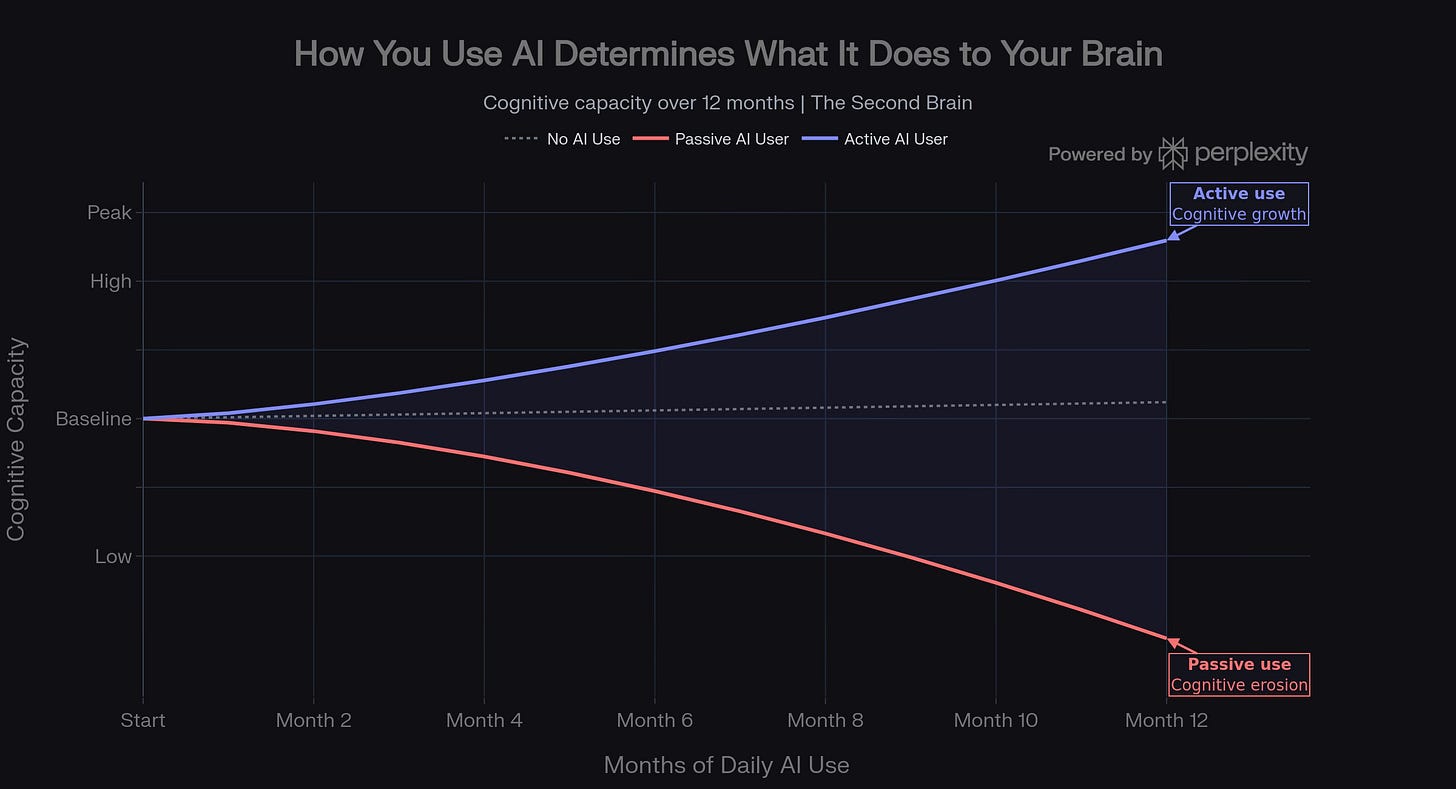
Their conclusion: passive, uncritical reliance on AI weakens activity-dependent brain plasticity and erodes cognition.
Let that land.
Not “might erode.” Not “could potentially.”
Erodes.
Here’s the mechanism, simplified so it actually means something:
Your brain has a threshold. When neural activity stays below that threshold — because you’re not being challenged, not generating answers, not sitting in productive struggle — it triggers something called Long-Term Depression in your synapses.
Not depression as in your mood.
Depression as in: synaptic connections literally weaken. The neurons that once fired together start firing less. The pathways you built through years of hard thinking begin to thin.
Meanwhile, MIT researchers found that cognitive activity scales down in direct proportion to generative AI use.
And Harvard published data showing daily AI users have 30% higher odds of reporting moderate depression than those who use it less. For people aged 45-65, that number jumps to 50%.
This isn’t alarmism. This is the early signal.
## The Paradox That’s Eating Your Edge
Here’s where it gets uncomfortable.
The people most likely to use AI every day are high performers. Creators. Founders. Knowledge workers. People who care about cognitive output.
You’re using AI because you want to think better.
But passive AI use is making you think worse.
You’re optimizing the output while degrading the engine.
It’s like taking the elevator every day to stay fit for a marathon.
And here’s what makes it insidious: it feels like thinking. You’re reading the outputs. Editing them. Commenting on them. Your brain registers the sensation of intellectual engagement without doing the actual work that builds the capacity for it.
The simulation of cognition isn’t cognition.
Scrolling food content isn’t eating.
Reading a workout routine isn’t training.
And prompting AI for your ideas isn’t building the mental muscle that lets you have ideas without it.
## The Attachment Nobody Talks About
There’s another layer here.
Research is showing that users are forming genuine psychological attachments to AI chatbots — patterns that mirror human attachment bonds. Some people feel guilt for missing a daily check-in with their AI.
That’s not productivity. That’s dependency with a productivity costume on.
And the mechanism is simple: AI gives you instant, personalized, frictionless validation. It never challenges you in ways that feel threatening. It never says “that idea is mediocre.” It agrees, elaborates, and sends you back into the world feeling competent.
Your brain learns to seek that loop.
Not because you’re weak.
Because you’re human. And your brain is doing exactly what it was designed to do: find the lowest-energy path to a reward signal.
The problem is what you’re trading for that feeling.
## This Isn’t an Anti-AI Article
want to be precise here, because the nuance matters.
The Nature study didn’t say AI destroys your brain.
It said passive AI use does.
Active co-creation — questioning, refining, pushing back, using AI as a sparring partner rather than an answer machine — does the opposite. It can raise neural activity above the threshold. It promotes Long-Term Potentiation: synapses strengthen, cognitive networks deepen.
The tool isn’t the problem.
How you hold the tool is the problem.
Most people are using a precision instrument as a crutch.
## The 3-Mode Framework: How to use AI Without Giving Your Mind Away
I’ve been stress-testing this personally for the past several months. Here’s what actually works.
Mode 1: Generate First, Then Consult
Before you open any AI tool, spend 10 minutes generating your own thinking. Write messy notes. Sketch out your perspective. Form an incomplete answer. Then use AI to pressure-test, expand, or challenge it.
This preserves the struggle that builds cognitive capacity. AI becomes the editor, not the author. You stay in the loop.
Mode 2: Argue With It, Don’t Accept It
When AI gives you an output, your default shouldn’t be “how do I use this?” It should be “where is this wrong?”
Disagreement is a cognitive workout. Agreement is rest.
The people building real depth right now are the ones using AI to surface counterarguments they then have to think through. That’s active co-creation. That’s the mode that strengthens your brain instead of thinning it.
Mode 3: Build Cognitive Reserves Without It
Two hours a day minimum — completely offline, completely self-directed.
Reading without highlights. Writing without prompts. Thinking in silence. Solving problems with friction.
Not because you’re anti-technology.
Because the mind you bring to the AI determines the quality of what comes out of it. Garbage in, garbage out. But more accurately: weakened mind in, weakened output — no matter how capable the model is.
Your brain is the product. Protect the product.
## The Real Competitive Advantage Nobody Sees Coming
In a world where everyone is using the same AI tools, the person who wins isn’t the most efficient prompter.
It’s the person with the strongest, most original, most deeply trained mind behind the prompts.
The bottleneck of the next decade isn’t access to AI.
It’s the quality of human thinking that directs it.
Which means — and this is the part most people sleep on — the people who deliberately preserve and build their cognitive capacity right now, while everyone else is offloading it, will have an asymmetric advantage that compounds for years.
You want leverage? This is leverage.
You want longevity? Cognitive longevity is the game nobody’s optimizing for yet.
The second brain isn’t your AI assistant.
It’s the one inside your skull — and it needs to stay sharp.
If this reframed something for you, share it with one person who needs to hear it. That’s how we grow this.
Subscribe
Message David Tost