Excerpt

Everything You Need to Know About the Hugging Face Model Hub and Community Image by Editor | Ideogram
Hugging Face has significantly contributed to the breakthrough of machine learning application technology, especially in the NLP field. They could contribute a lot because Hugging Face focuses on building a platform for the community to easily access models, tools, and datasets to the public. That’s why Hugging Face has become a place to contribute to and showcase many machine learning works.
As the Hugging Face platform is essential for world technology breakthroughs, we should understand more about the Hugging Face Hub platform. This article will focus more on the Model Hub and the Community, where most work happens.
Let’s jump into it.
## Hugging Face Hub Platform in General
As mentioned above, Hugging Face is a company focused on machine learning development

Everything You Need to Know About the Hugging Face Model Hub and Community Image by Editor | Ideogram
Hugging Face has significantly contributed to the breakthrough of machine learning application technology, especially in the NLP field. They could contribute a lot because Hugging Face focuses on building a platform for the community to easily access models, tools, and datasets to the public. That’s why Hugging Face has become a place to contribute to and showcase many machine learning works.
As the Hugging Face platform is essential for world technology breakthroughs, we should understand more about the Hugging Face Hub platform. This article will focus more on the Model Hub and the Community, where most work happens.
Let’s jump into it.
## Hugging Face Hub Platform in General
As mentioned above, Hugging Face is a company focused on machine learning development by building a platform that allows easy access for sharing and contributing to the community. The platform is called Hugging Face Hub.
Hugging Face Hub is a platform that hosts publicly available and open-source models, datasets, and apps. The community can easily access everything in the Hub individually or in collaboration. The Hub’s structure is shown below.
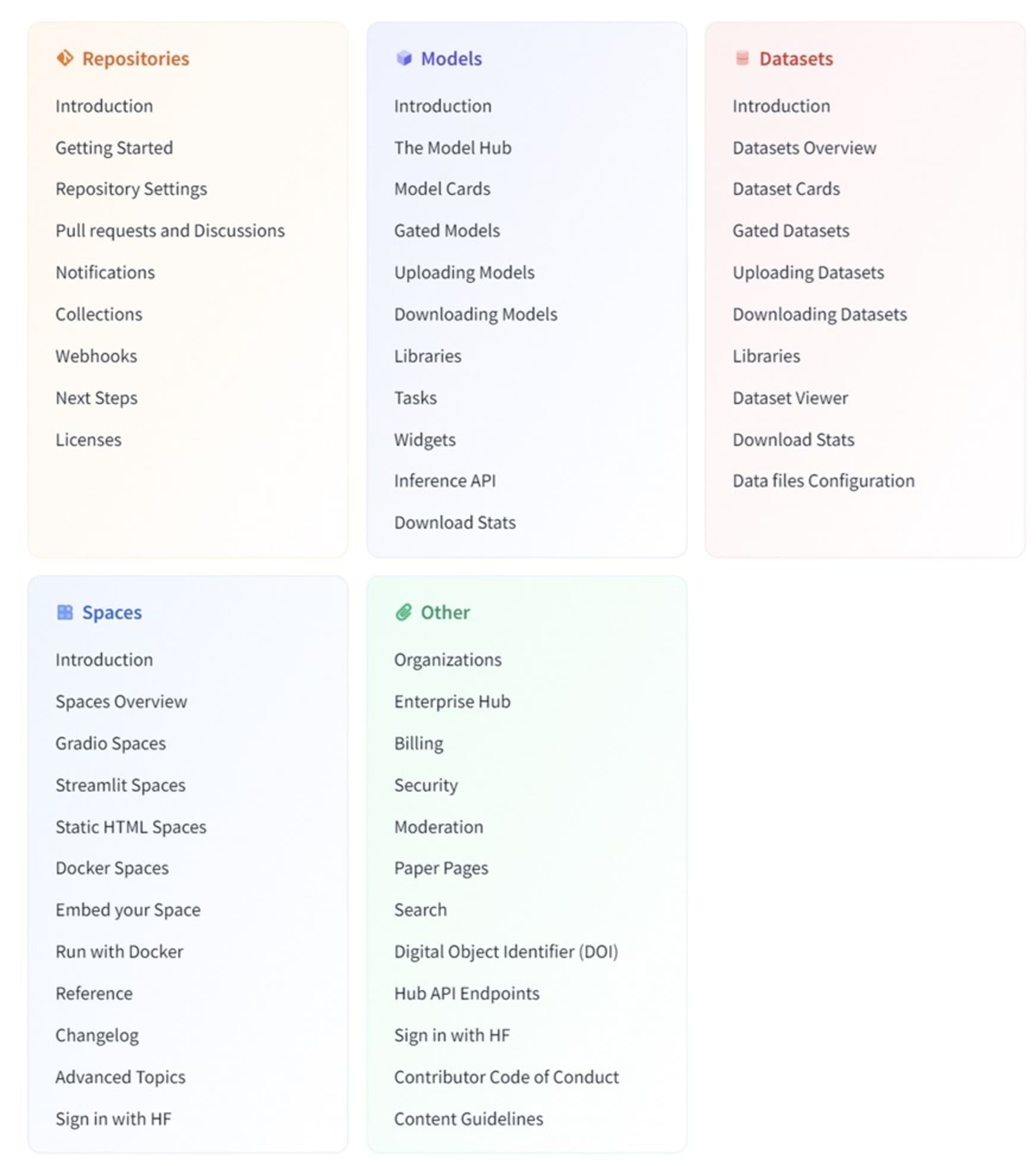
Hugging Face Hub Structure
Let’s explore how the Hugging Face Model Hub works.
## Hugging Face Model Hub
The Hugging Face Hub model is where the model is hosted for various machine learning tasks, such as image classification, question-answering, text-to-speech, and many more. The community can use the model hub to share and discover any valuable model for downstream tasks.
Let’s break down the key elements of the Model Hub.
## Model repository
The first thing we explore is the Model Repository. The Model repository is similar to the GitHub repository, where users can upload and share models with the public. You can see an example of the Model repository in the image below.
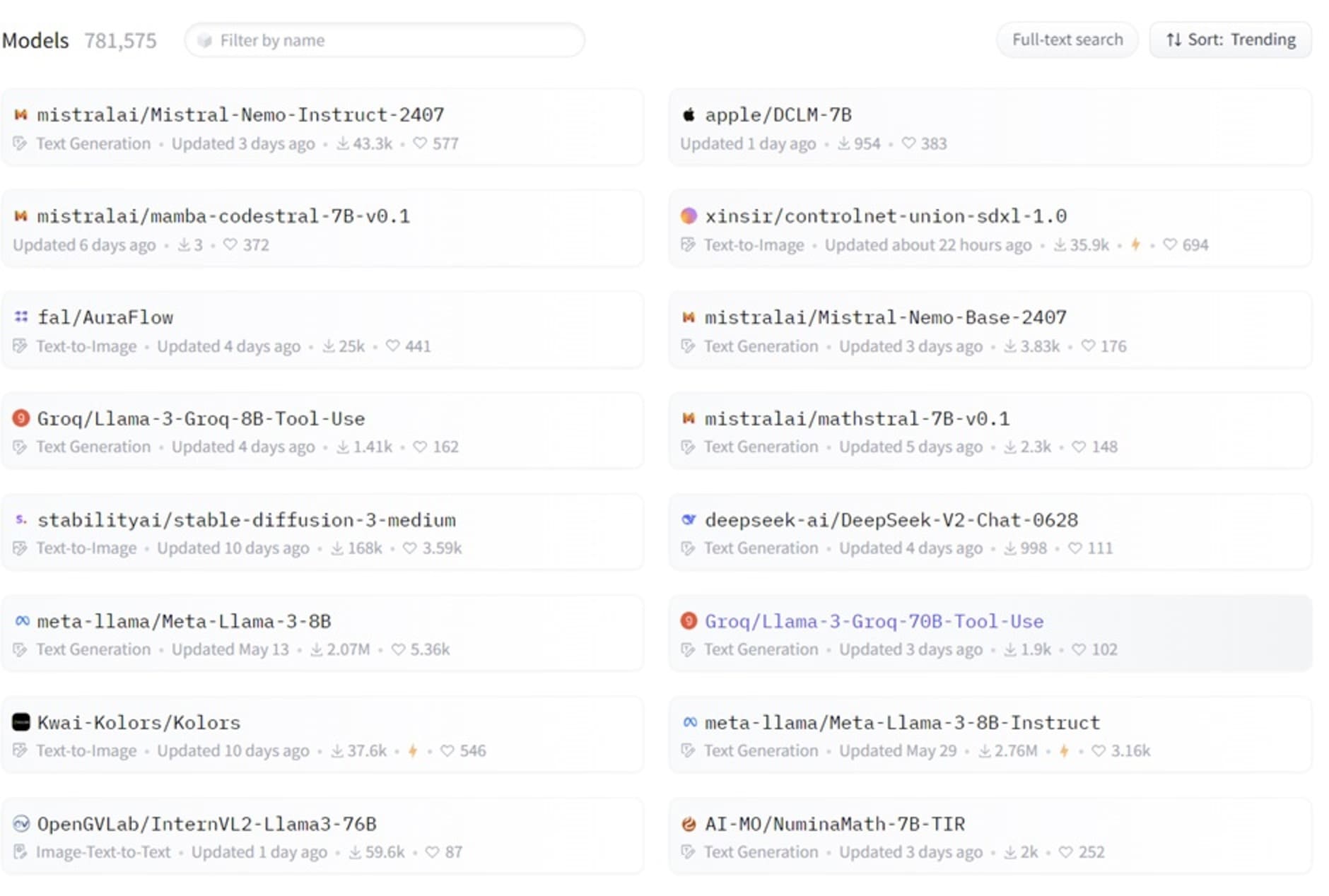
Model Repository Example
Each repository could store the models we have trained for specific tasks. Users can upload the model in formats like PyTorch, TensorFlow, or JAX. Let’s select one of the repositories and see what is inside.

Mistral-Nemo-Instruct-2407 Repository
The image above is the repository for the Mistral-Nemo-Instruct-2407 pre-trained model. It contains many pieces of information, including the Model Card, Files and Versions, and Community. Let’s understand for each one.
The Model Card contains comprehensive information about the model. You can fill it with information, including model architecture, training data, usage instructions, and model performance.
The repository also supports file storage, including the configuration and model weights. It comes with version control for the model, which allows the user to track any changes each time we update it and revert to an older version if necessary.
In each repository, you can create a discussion thread and new pull requests to collaborate with the community. This feature is similar to the GitHub repository if you are familiar with it.
Lastly, the Model Repository has the downloaded statistical information, training code template, deployment code template, and inferential API for testing the model. Additionally, there is information on which Hugging Face space uses the model.
## Model Hub Search
With so many repositories within the Hugging Face Model Hub, it’s hard to find the models we need if we randomly select them individually. That’s why there is a search bar.
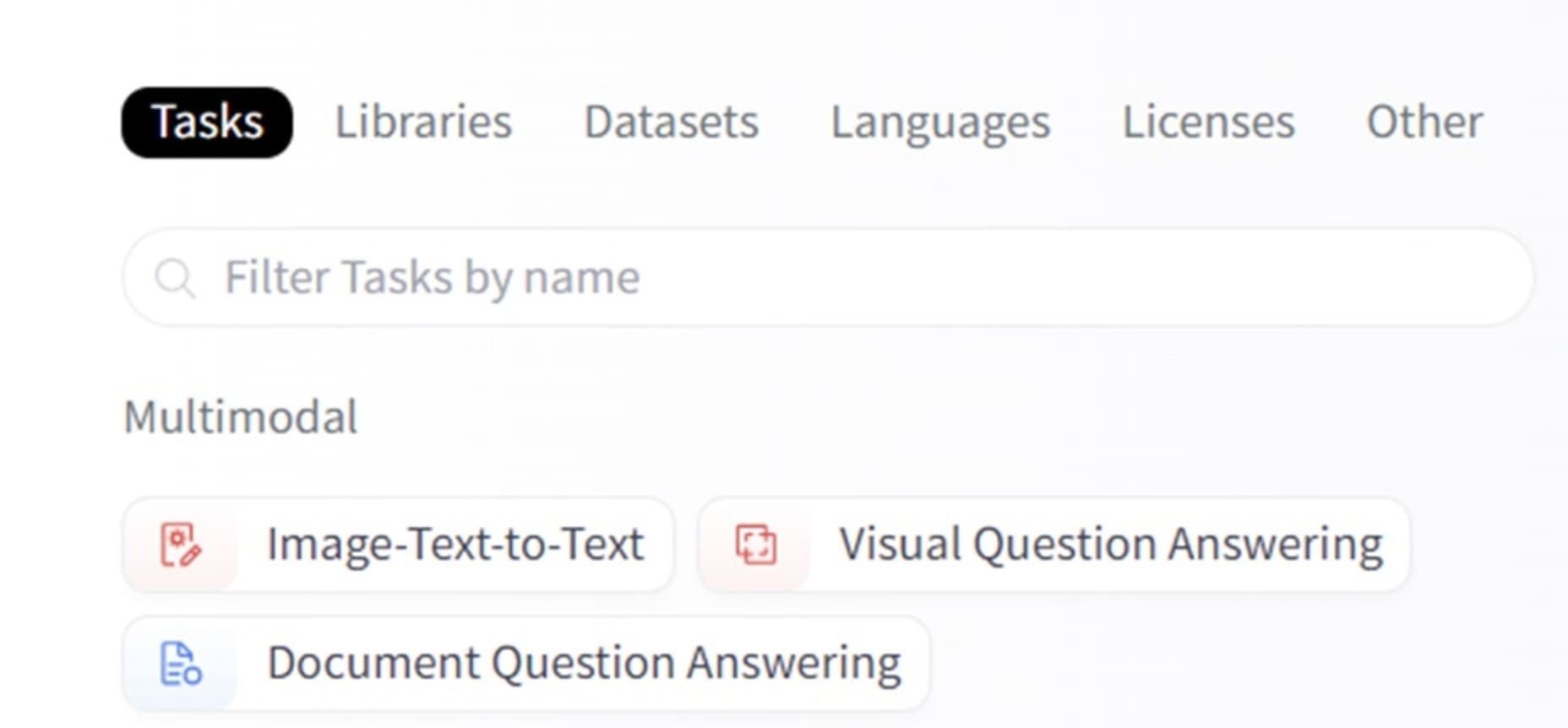
Hugging Face Model Hub Search
You can search the model using keywords related to your requirements, such as the machine learning tasks or the model framework. Ideally, each repository is tagged with relevant descriptions, such as the tasks, framework, dataset used, etc. If the repository is tagged correctly, you can also use it to filter by selecting the tabs (Tasks, Libraries, Datasets, Languages, Licenses, Other).
For a more broad search, you can use the full-text search.

Hugging Face Full-Text Search
You can look for the model repositories containing the text you input using the full-text search.
## Model Hub Integration
Once you select the model you want to use in the Hugging Face Model Hub, you can download all the files manually, or we can use the huggingface_hub library to interact with the repository. Let’s try them out.
First, we need to install the library.
Next, you must acquire the user access token from your settings page.
After setting it, we can interact with the Model Hub repositories. For example, I would try to download a file from Model Repositories.
It’s also possible to download a specific file with a particular version.
You can also create your model repository and upload your files, such as config files or Model.
Then, we can upload the files to your repositories using the following code:
For further usage of the Model from the Model Hub, you can check out the Transformers documentation from Hugging Face.
That’s all the basics for the Model Hub. Let’s move on to the Hugging Face Community.
## Hugging Face Community
I have mentioned a community in the Model Repository where you can discuss the model and create a pull request. However, the Hugging Face community is more than that. If you look at the drop-down on the Hugging Face website, it contains many community pages similar to the image below.

Hugging Face Community Pages
Let’s try to break them down to understand better.
## Hugging Face Community Blog Articles
The name is self-explanatory, as the Community Blog Articles section contains blog post and articles published from the community to the community. You can create your article, but must subscribe to the Hugging Face Pro subscription.
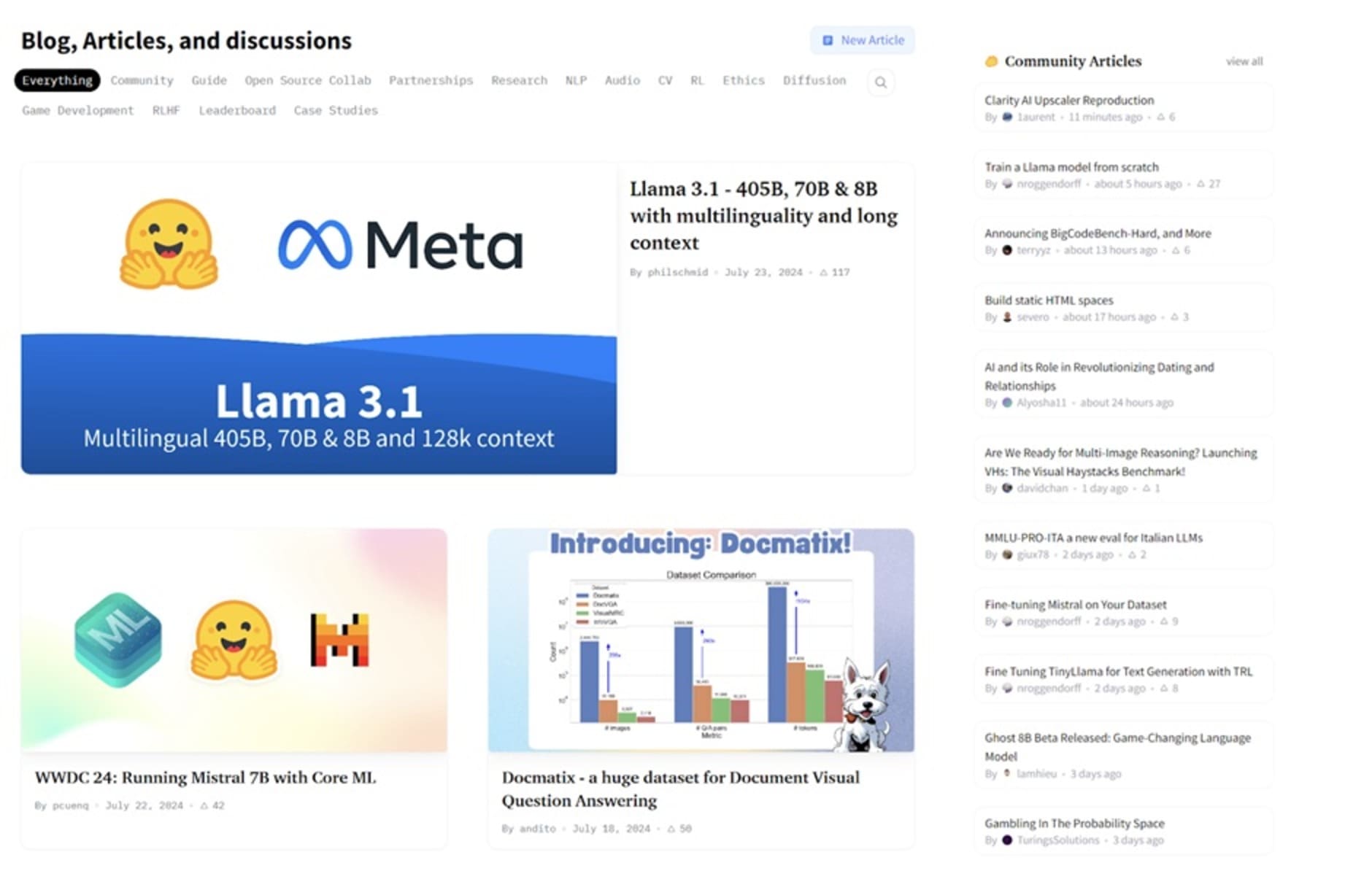
Hugging Face Community Blog Articles
You can read many blogs and articles here and filter them by tag. Try to explore them, as you can learn a lot from community blogs and articles.
## Hugging Face Community Learn
Speaking of learning, Hugging Face also provides the community with various topics, such as NLP, Computer Vision, and many more.
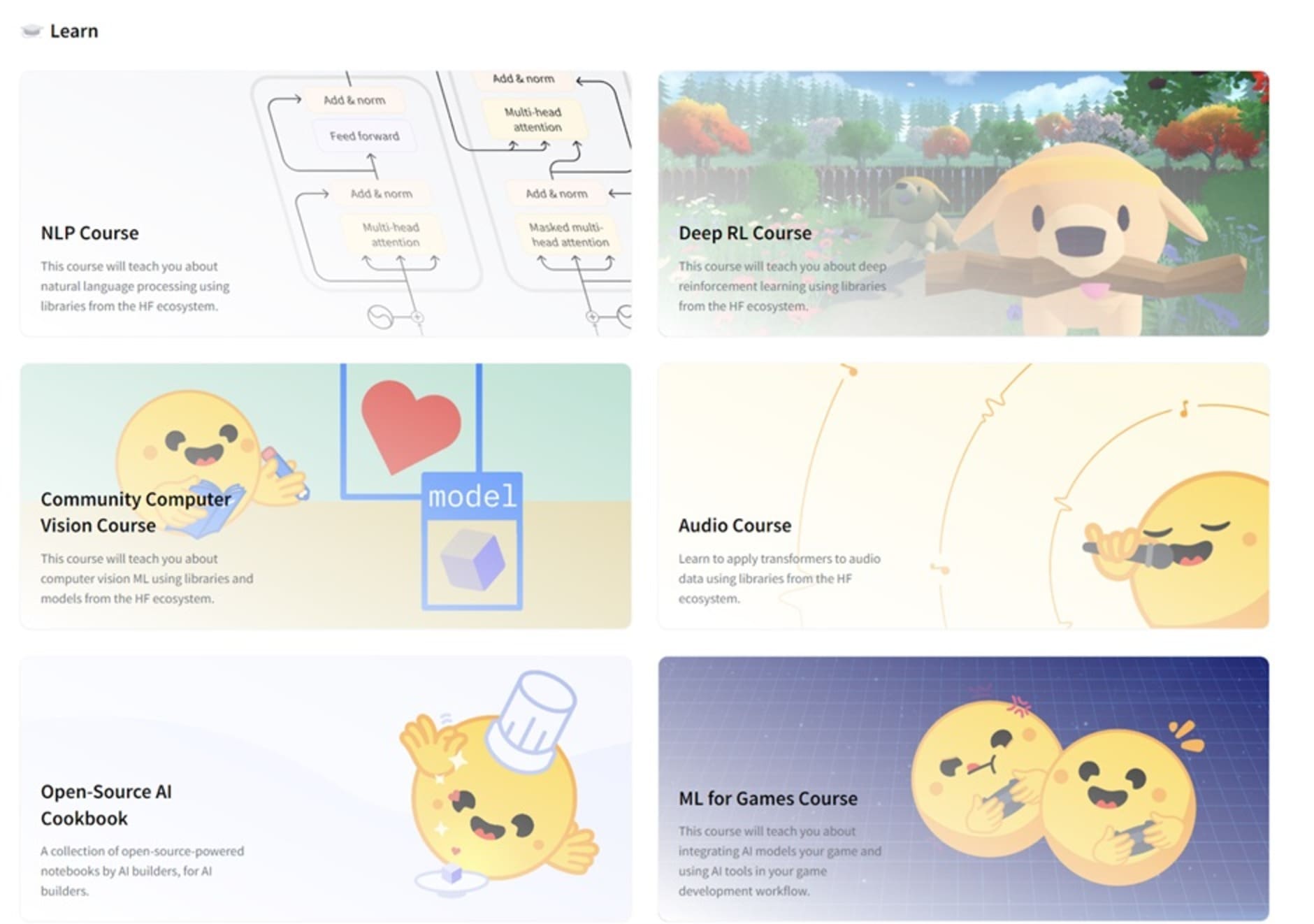
Hugging Face Community Learn
Each course is self-learning without any time limit, and you can always revisit it in any way you want. The course example is in the image below.
Try to use this platform as learning material, as it will be helpful for your future career.
## Hugging Face Community Forum
You can join the Hugging Face Forum if you are into old-style discussions. In this forum, you can create topics and answer questions from the community. The forum is similar to the image below.
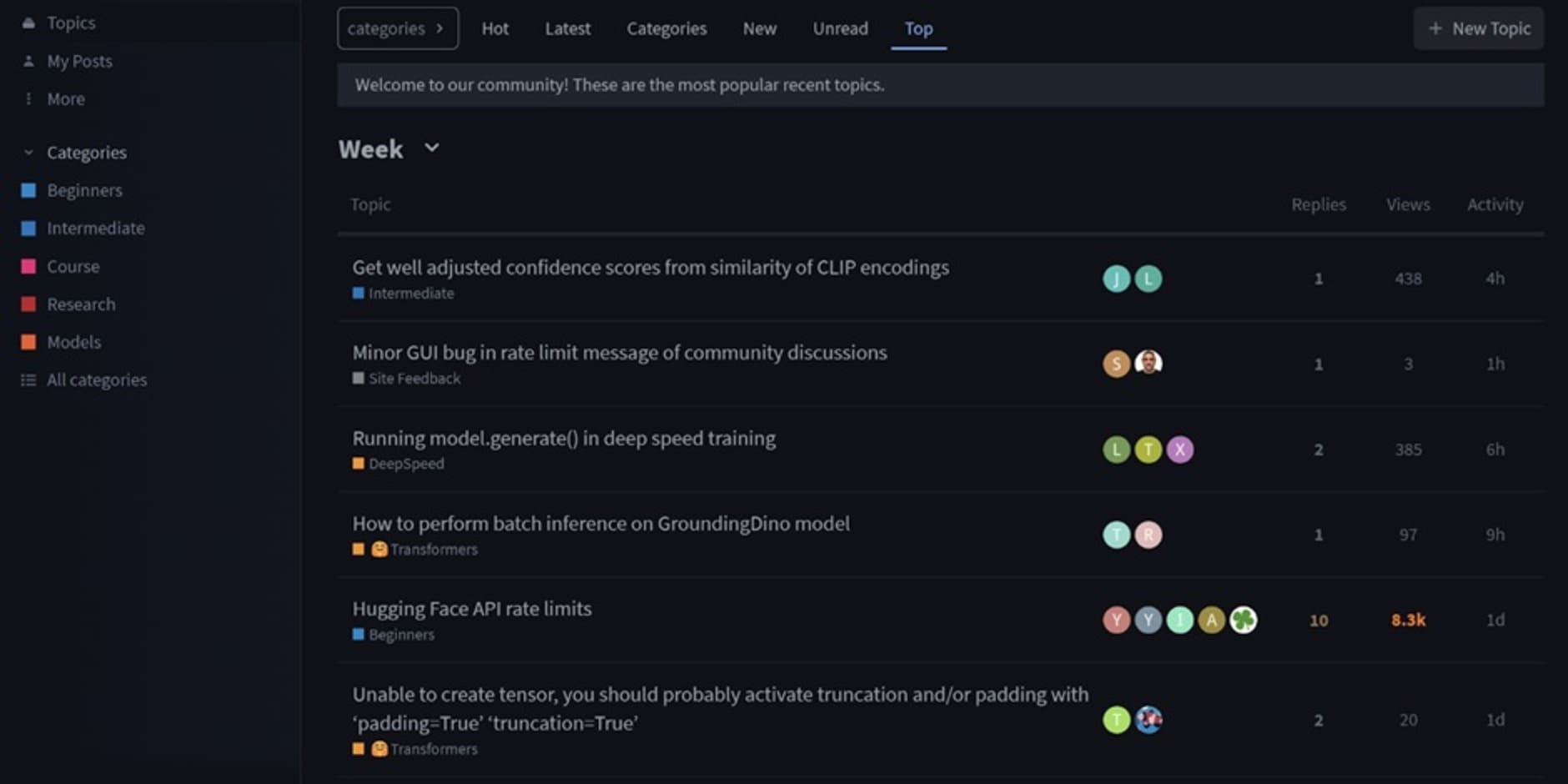
Hugging Face Community Forum
You can also filter the categories to suit your needs. The forum is a great place to discuss with the community if you need more detailed answers.
## Hugging Face Community Discord
If you prefer direct live chat, you can do that via Hugging Face Community Discord. After accepting the invite, you will be directed to the Community Discord.
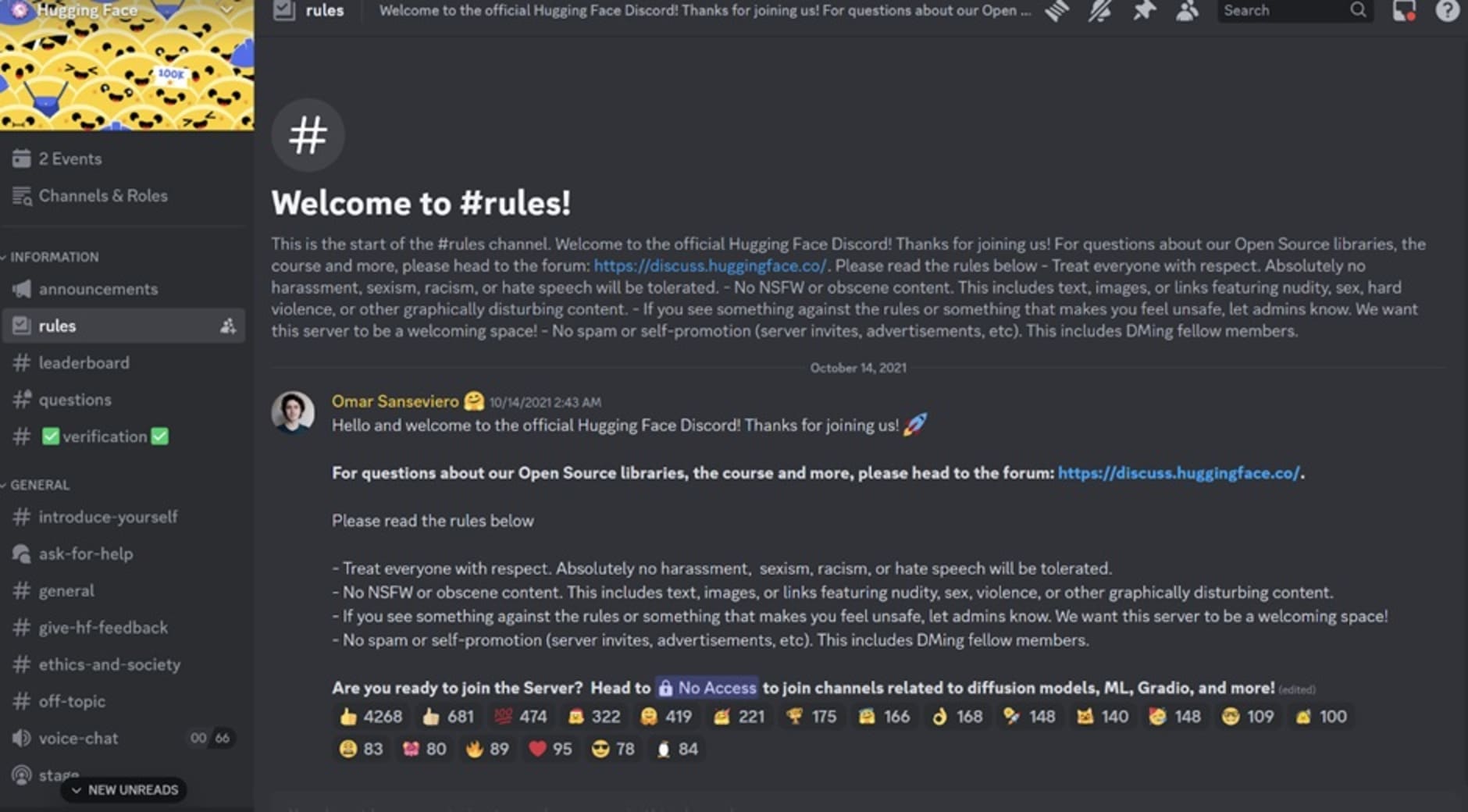
Hugging Face Community Discord
You need to visit four different starter channels and verify your username using the Hugging Face User Access Token you previously created. Then, go to the LevelBot private message and chat with the bot using the following command.
Once verified, you will get the message and be free to explore the community.
## Hugging Face Community GitHub
Hugging Face is often dubbed the GitHub of Machine Learning, but it still hosts many of its libraries, utilities, learning materials, and other resources in GitHub repositories.
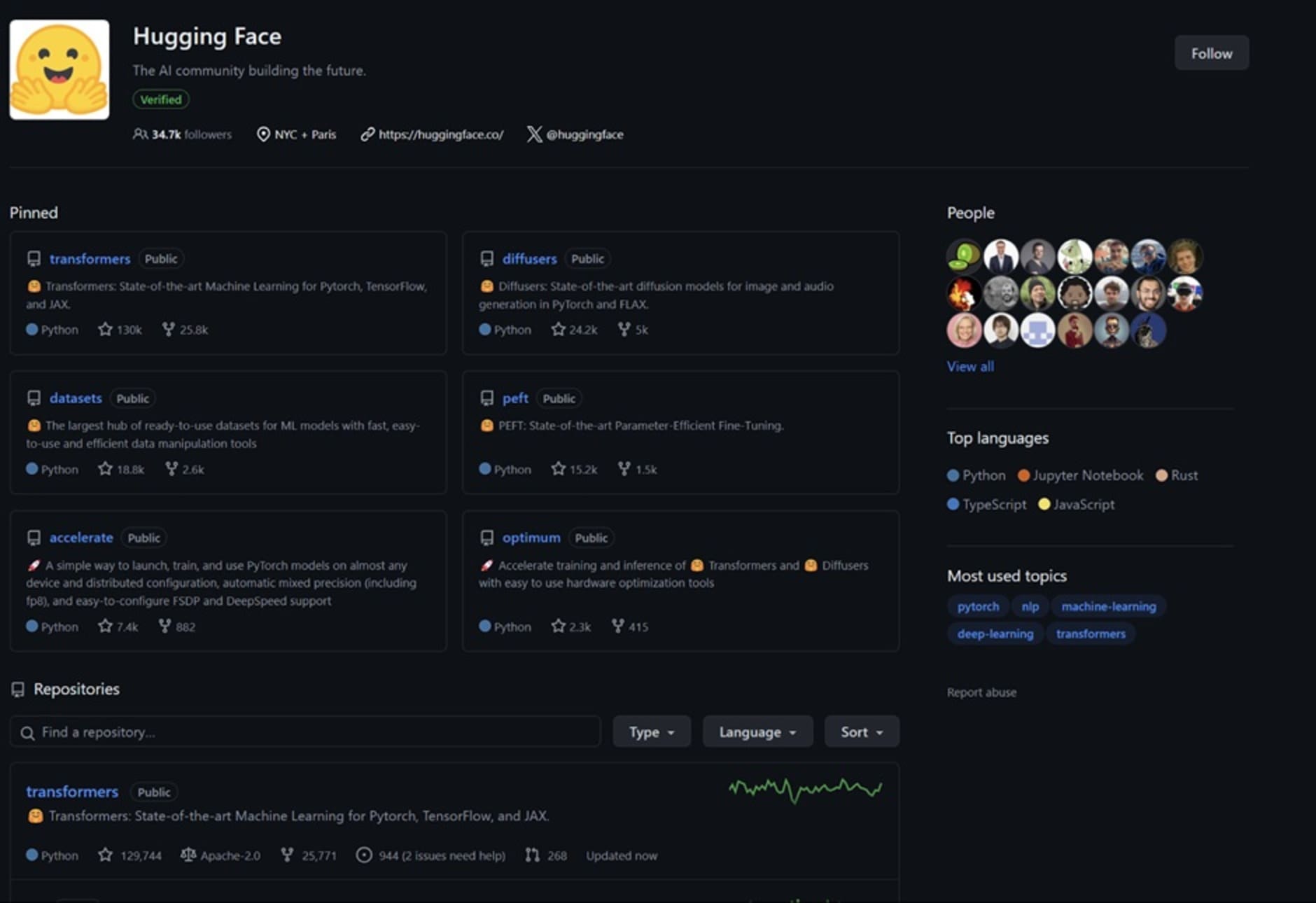
Hugging Face Community GitHub
As of the time of this article, there are around 235 repositories you can explore and discuss with the community. You can also contribute to the open-source project hosted in the Hugging Face GitHub.
## Conclusion
Hugging Face is an important platform for machine learning development. It allows the community to easily access models, datasets, applications, and more in an open-source manner.
This article focuses on exploring the Hugging Face Model Hub and Community. These two features make the Hugging Face renowned, and you should also know about them.

5 Groundbreaking Applications of Reinforcement Learning in 2024 Image by Editor | Ideogram
Reinforcement Learning (RL) has emerged as a powerful paradigm in artificial intelligence, enabling machines to learn optimal behavior through interaction with their environment. In RL, an agent learns to make decisions by performing actions and receiving rewards or penalties, ultimately aiming to maximize cumulative rewards over time. This approach has led to remarkable advancements across various domains, from gaming to robotics.
As we explore the developments in 2024, it’s important to understand that the distinction between “new” and “established” applications in RL is often unclear. The field’s rapid evolution means that many seemingly novel applications are, in fact, sophisticated advancements or specialized implementations of concepts that have been in development for years. The true innovation often lies in the specific implementations, the scale of deployment, or the unprecedented levels of effectiveness achieved.
## Established Applications of Reinforcement Learning
Before we explore the cutting-edge applications of 2024, let’s briefly acknowledge some well-established areas where RL has already made significant impacts:
1. Autonomous Vehicles: RL has been instrumental in developing decision-making algorithms for self-driving cars, enabling them to navigate complex environments.
2. Robotics: Industrial robots and robotic systems have long benefited from RL, learning to perform tasks through trial and error.
3. Financial Trading: Algorithmic trading strategies powered by RL have been optimizing investment decisions for years.
4. Game Playing: RL’s application in mastering complex games like Go and chess has been a landmark achievement in AI.
These applications continue to evolve, with ongoing research pushing the boundaries of what’s possible. However, 2024 has seen some truly groundbreaking applications that deserve special attention.
## 1. Precision Healthcare Optimization
While RL in healthcare isn’t entirely new, 2024 has seen unprecedented advancements in personalized treatment optimization. RL algorithms are now capable of fine-tuning chemotherapy and radiotherapy dosing schedules with remarkable precision. These systems analyze vast amounts of patient data, including genetic information, treatment history, and real-time physiological responses, to dynamically adjust treatment plans.
What sets 2024’s applications apart is their ability to adapt in real-time to patient responses, minimizing side effects while maximizing treatment efficacy. This level of personalization was previously unattainable and represents a significant leap forward in patient care.
## 2. Advanced Natural Language Processing for Diverse Languages
RL has made substantial strides in NLP, particularly in developing more sophisticated dialogue systems and chatbots. The breakthrough in 2024 lies in the ability of these systems to learn and adapt to a wide range of languages and dialects, including those with limited digital resources.
These new RL-powered language models can now understand and generate contextually appropriate responses in real-time, adapting to individual user’s speech patterns, idioms, and even code-switching between multiple languages. This advancement has significant implications for global communication, education, and accessibility.
## 3. Resilient Supply Chain Optimization
While supply chain optimization using RL isn’t new, the events of recent years have highlighted the need for more resilient and adaptive systems. In 2024, RL algorithms are being deployed to create supply chain networks that can quickly adapt to global disruptions, from pandemics to geopolitical tensions.
These advanced systems not only optimize for efficiency but also for resilience, learning from simulated crisis scenarios to develop robust strategies. They can predict potential disruptions, suggest alternative suppliers or routes, and even recommend strategic inventory placement, all in real-time.
## 4. Eco-Friendly Smart Grid Management
Energy management systems have utilized RL for years, but 2024 has seen a significant leap in their capabilities, particularly in managing renewable energy sources. The latest RL algorithms can balance supply and demand across complex grid systems with unprecedented efficiency.
What’s groundbreaking is their ability to integrate a diverse range of energy sources, including residential solar panels, wind farms, and electric vehicle batteries, creating a truly decentralized and resilient energy network. These systems can predict energy consumption patterns, optimize storage, and even incentivize consumer behavior to balance grid load, all while minimizing carbon footprint.
## 5. Multimodal Learning for Robotic Assistants
The field of robotics has seen remarkable advancements through RL, but 2024 brings us closer to the realization of truly versatile robotic assistants. The latest breakthrough lies in multimodal learning, where robots use RL to integrate information from various sensory inputs – vision, touch, sound, and even natural language instructions.
These advanced robotic systems can now learn complex tasks by observing human demonstrations, understanding verbal instructions, and adapting to new environments with minimal reprogramming. This represents a significant step towards robots that can assist in diverse scenarios, from healthcare and elderly care to disaster response and household tasks.
## Looking Ahead
As we witness these groundbreaking applications of reinforcement learning in 2024, it’s clear that we’re only scratching the surface of RL’s potential. The field continues to evolve rapidly, with researchers and practitioners pushing the boundaries of what’s possible.
The convergence of RL with other AI technologies, such as deep learning and quantum computing, promises even more exciting developments in the near future. As these systems become more sophisticated and are deployed in increasingly critical roles, it’s essential to consider the ethical implications and ensure responsible development and deployment.
These developments are not only technologically significant but also bring substantial social and economic benefits. The advancements in healthcare optimization are improving patient outcomes and potentially saving lives. Eco-friendly smart grid management is enabling more sustainable energy practices, contributing to the fight against climate change. The creation of resilient supply chains helps to stabilize economies and ensure the availability of essential goods even in times of crisis. Moreover, the progress in natural language processing and robotic assistants has the potential to break down communication barriers and provide vital support to those in need.
Reinforcement learning in 2024 is proving to be more than just a technological marvel—it’s a driving force for positive change across various sectors of society, promising a future where AI works hand in hand with humans to address some of our most pressing challenges.
-
5 Free Courses on Reinforcement Learning

-
Principles of Reinforcement Learning: An…

-
7 Free Machine Learning Tools Every Beginner Should…

-
Machine Learning Salaries and Job Market Analysis for 2024 and Beyond

-
10 Must-Know Python Libraries for Machine Learning in 2024

-
5 Free Courses to Master Deep Learning in 2024

5 Influential Machine Learning Papers You Should Read Image by Editor | Ideogram
In recent years, machine learning has experienced a profound transformation with the emergence of LLMs and new techniques that improved the domain’s state of the art. Most of these advancements have mainly been initially revealed in research papers, which have introduced new techniques while reshaping our understanding and approach to the domain.
The number of papers has been explosive, so today let’s try to summarize 5 of the most influential that have contributed to the advancement of machine learning.
## 1. Attention is All You Need
This seminal paper introduced the Transformer model. And as most of you might already know, this has revolutionized natural language processing by eliminating the need for recurrent neural networks.
The key innovation is the self-attention mechanism, which allows the model to focus on different parts of the input sequence, leading to more efficient parallelization and improved performance.
This paper is crucial because it laid the groundwork for many state-of-the-art models, such as BERT and GPT, transforming the landscape of language understanding and generation.
It is considered the starting point of the LLM wave we are currently experiencing.
## 2. Neural Networks are Decision Trees
This paper presents a novel perspective by showing that neural networks can be interpreted as decision trees. This insight bridges the gap between two major paradigms in machine learning, offering a new way to understand and visualize the decision-making process of neural networks.
The importance of this paper lies in its potential to enhance interpretability and transparency in neural network models, which are often criticized for being black boxes.
## 3. On the Cross-Validation Bias due to Unsupervised Preprocessing
This paper addresses a critical issue in model evaluation: the bias introduced by unsupervised preprocessing steps during cross-validation.
It highlights how common practices can lead to too-optimistic performance estimates, thus affecting the reliability of model assessments.
The importance of this paper relies in the generation and standardization of guidelines for more accurate evaluation practices, ensuring that machine learning models are truly robust and generalizable.
## 4. LoRA: Low-Rank Adaptation of Large Language Models
One of the biggest problems of LLMs is the amount of resources they require (and consume!). This is where another influential paper played a key role in providing a new technique to reduce this drastically: LoRA introduces a method for efficiently adapting large language models to specific tasks by using low-rank adaptation techniques.
This approach significantly reduces the computational resources required for fine-tuning large models, making it more accessible and practical for various applications.
This paper has contributed to making large-scale models more adaptable and cost-effective, broadening their usability across different domains.
## 5. Grokking: Generalization Beyond Overfitting on Small Algorithmic Datasets
This paper explores the phenomenon of “grokking,” where models trained on small datasets initially overfit but eventually learn to generalize well.
It provides insights into the dynamics of learning and generalization, challenging traditional views on overfitting and model capacity. The importance of this work is in its potential to inform new training strategies and model architectures that can achieve better generalization from limited data.
Each of these papers represents a significant leap forward in understanding and applying machine learning techniques. They provide crucial insights into model architecture, evaluation, adaptation, and generalization, making them essential reading for anyone serious about advancing their knowledge in this field.
Moreover, the first paper introduced has been particularly influential in launching one of the most exciting areas of recent years — LLMs — which will likely continue to shape the future of machine learning.
-
5 of the Most Influential Machine Learning Papers of 2024

-
5 Free Books on Machine Learning Algorithms You Must Read

-
Why you should be Spot-Checking Algorithms on your…

-
5 Machine Learning Areas You Should Be Cultivating

-
5 Breakthrough Machine Learning Research Papers…
-
How do you generate synthetic data for machine…